
A school-zone pedestrian accident can leave a New Mexico family managing medical care, missed school, insurance calls, and unanswered questions. A school zone pedestrian accident lawyer New Mexico families trust can investigate what happened, identify responsible parties, and protect evidence before it disappears.
Talk with Fusion Legal Group about a New Mexico school-zone pedestrian accident
This guide explains how negligence may be proven after a child or adult is struck near a school. It focuses on New Mexico traffic duties, crossing guards, posted school zones, evidence preservation, public-entity notice rules, comparative fault, and potential damages. Every case turns on its specific facts.
What makes a school-zone pedestrian accident different?
A school-zone pedestrian accident involves a collision or near collision connected to a school arrival area, dismissal route, school crossing, marked crosswalk, or nearby roadway. The location does not automatically establish liability. It does create important questions about posted signs, traffic controls, driver behavior, crossing-guard directions, and the presence of children.
These accidents may involve a child walking, a parent accompanying a child, a student using a bicycle or scooter, or an adult crossing near school property. They can happen before classes, during dismissal, after activities, or at a nearby bus stop. A school connection alone does not determine which law applies.
Investigators usually need to identify the exact location and time. A road may have different rules at a marked school crossing, a signalized intersection, a private driveway, or a municipal street. The posted speed limit and any flashing warning device can also matter.
Fusion Legal Group’s New Mexico pedestrian accident resource addresses the broader injury and claim process. This article narrows the focus to the evidence and legal issues that often arise around school zones.
How does New Mexico law define a driver’s duties near children?
New Mexico drivers must use reasonable care around pedestrians and take proper precautions when observing a child on a roadway. The state’s traffic laws also address school-zone speed, school crossings, and the need to control speed to avoid a collision. A traffic violation can support a negligence argument, but the full claim still requires proof of causation and injury.
New Mexico Statutes Section 66-7-337 says every driver must exercise due care to avoid colliding with a pedestrian. It also requires proper precaution when a driver observes a child or a confused or incapacitated person on a roadway.
New Mexico Statutes Section 66-7-301 addresses speed regulation. It identifies a 15-mile-per-hour limit when passing a school while children are going to or leaving school and the school zone is properly posted. The same statute requires speed control to avoid colliding with a person or vehicle.
New Mexico Statutes Section 66-7-336 addresses school crossings. It describes how crossings may be established and marked, and it assigns different responsibilities based on whether the road is a state highway or a local street.
- Drivers must pay attention to pedestrians and changing conditions.
- Drivers must obey posted speed limits and traffic-control devices.
- Drivers must use proper precautions when they see a child near the roadway.
- Drivers must respond appropriately to a marked crosswalk or crossing-guard direction.
- Drivers must maintain control and a reasonable lookout for the conditions.
A family should avoid assuming that a ticket, sign, or school-zone designation automatically wins a civil case. The evidence must connect the conduct to the collision and the child’s injuries.
Which evidence can prove negligence after a school-zone collision?
Negligence is usually shown through a combination of driver conduct, traffic conditions, witness accounts, physical evidence, and medical records. The strongest investigation compares what the driver should have seen and done with what the driver actually did. It also connects the breach to the specific harm suffered.
| Issue | Evidence to preserve | What it may help show |
|---|---|---|
| Speed | Traffic-camera footage, vehicle data, skid marks, damage, witness estimates, and posted signs | Whether the driver exceeded a posted limit or failed to control speed |
| Lookout | Driver statements, sight lines, parked-car locations, lighting, and dash-camera footage | Whether the pedestrian should have been visible before impact |
| Crosswalk use | Photos, measurements, signal timing, markings, and witness accounts | Where the pedestrian entered and what traffic controls applied |
| Distraction | Phone records obtained through proper legal process, vehicle data, admissions, and witness testimony | Whether attention was diverted from the roadway |
| Causation | Police report, crash reconstruction, vehicle damage, and medical records | How the driver’s conduct caused the collision and injuries |
Speed, signs, and school-zone timing
Photograph every sign from the driver’s approach, not only from the sidewalk. Record whether a sign was visible, blocked, damaged, turned away, or paired with a flashing beacon. Note the date, time, weather, traffic volume, and whether children were arriving or leaving school.
The New Mexico Court of Appeals considered school-zone posting in Weiland ex rel. Weiland v. Vigil. The opinion explains that the school-zone sign was necessary before the special school-zone speed rule applied in that case. Read the Weiland v. Vigil opinion with the current roadway facts in mind. Do not assume an old case answers every modern school-zone question.
Crosswalks and crossing guards
Witnesses should describe the crossing guard’s location, clothing, gestures, and timing. A guard’s direction may be especially important when traffic is stopped in one lane but moving in another. Identify the guard promptly because schedules and contact information may change.
Albuquerque has a local rule addressing a uniformed school crossing guard who signals a driver to stop in an appropriately marked school zone. The Albuquerque school-zone ordinance is location-specific. Other New Mexico municipalities may have different rules, so the exact city and road authority matter.
Distraction, impairment, and failure to yield
Evidence of distraction can include a driver’s statement, witness observations, vehicle infotainment data, or records obtained during a formal investigation. Do not attempt to access another person’s private phone or account. Preserve what you lawfully have and provide it to counsel or law enforcement.
Failure to yield is not limited to a driver looking down at a phone. A driver may fail to see a child because of speed, an obstructed view, an improper pass, a turn, or an unsafe position near a crosswalk. The investigation should examine the whole approach to the collision.
How should a family preserve evidence involving a child?
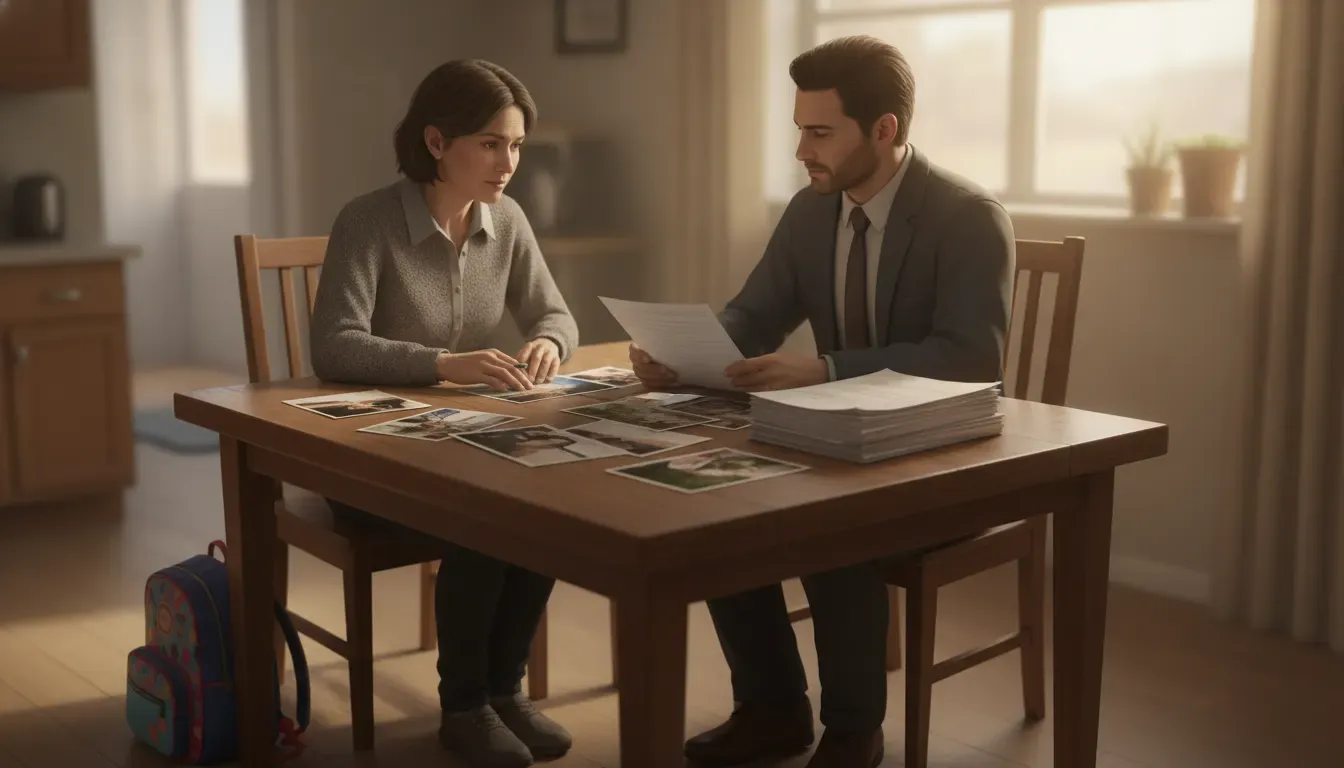
Families should preserve evidence quickly because school-zone footage, nearby business video, witness memories, and temporary traffic conditions can change. Parents should focus first on medical care and safety. Once the child is stable, create a record of the scene, the child’s symptoms, and the people who may have observed the event.
- Request the police report and keep the incident number.
- Photograph the roadway, crosswalk, signs, flashing lights, sidewalks, visibility, and vehicle damage.
- Write down the names and contact information of witnesses, crossing guards, school staff, and nearby businesses.
- Ask a lawyer to send preservation requests for school, city, traffic-camera, bus, and business video.
- Save photographs, messages, clothing, shoes, helmets, backpacks, and other physical evidence.
- Keep medical records, bills, prescriptions, therapy notes, and follow-up instructions.
- Track pain, sleep changes, emotional symptoms, activity limits, missed school, and care provided at home.
- Keep a calendar showing medical appointments, school absences, tutoring, transportation, and family time spent on care.
Do not repair or discard damaged personal items before photographing them. Do not post accident photographs or commentary on social media. A parent should also avoid giving a recorded statement to an insurer before understanding the questions and the claim’s full scope.
Can a school district, city, or other public entity be responsible?
A school, city, county, or state agency is not automatically liable because an accident happened near school property. A public-entity claim may involve a separate analysis under the New Mexico Tort Claims Act. Immunity, a statutory waiver, notice, causation, and the entity’s role must all be reviewed promptly.
Potential theories may involve an allegedly unsafe public crossing, a missing or misleading traffic control, roadway maintenance, or a public employee’s conduct. The facts may also show that a private driver caused the collision. Identifying every possible party requires care because the law does not treat a school, school district, municipality, and state agency as interchangeable.
New Mexico Statutes Section 41-4-16 generally requires written notice within 90 days for a claim under the Tort Claims Act, unless an exception applies. The notice must identify the time, place, and circumstances of the loss or injury. Actual notice and incapacity rules can affect the analysis, but they should not be assumed.
New Mexico Statutes Section 41-4-15 addresses a two-year limitation period for actions against a governmental entity or public employee, with statutory exceptions. This is different from the deadline that may apply to a claim against a private driver.
If a public entity may be involved, tell a lawyer that immediately. Waiting for a school or city investigation to finish can allow video, maintenance records, sign records, or witness information to disappear.
How can comparative fault affect a New Mexico claim?
New Mexico may assign fault to more than one person, and a pedestrian’s assigned share can affect the amount recovered. A child being outside a marked crosswalk or a parent looking away for a moment does not automatically eliminate a claim. The facts, the child’s age, the roadway, and each person’s conduct all matter.
Insurance carriers may argue that the pedestrian, parent, crossing guard, school, or another driver contributed to the event. Those arguments should be tested against photographs, timing, sight lines, traffic controls, witness accounts, and expert analysis when needed.
New Mexico Statutes Section 41-3A-1 addresses several liability and the allocation of fault among persons whose conduct proximately caused an injury. It does not create a new cause of action or replace the need to prove causation.
Children and adults are not evaluated in exactly the same way in every factual setting. A lawyer should examine the child’s age, expected judgment, supervision, traffic conditions, and the driver’s heightened need for caution around a school. Avoid accepting a percentage of fault from an insurer before the evidence is developed.
What damages may be available after a school-zone pedestrian accident?
Damages depend on the child’s injuries, recovery, future needs, financial losses, and the legally responsible parties. A claim may include current losses and reasonably supported future consequences. Families should document both visible injuries and less obvious effects that develop after the collision.
| Potential loss | Helpful documentation |
|---|---|
| Emergency and medical care | Ambulance records, hospital bills, physician notes, prescriptions, and diagnostic testing |
| Rehabilitation and future care | Therapy records, treatment plans, medical opinions, equipment needs, and projected care |
| School disruption | Attendance records, missed assignments, tutoring, special accommodations, and teacher observations |
| Household and family support | Care calendars, transportation records, childcare, and changes in ordinary family activities |
| Pain and emotional effects | Medical notes, counseling records, symptom journals, family observations, and activity changes |
| Long-term impairment | Specialist opinions, prognosis, future treatment, and evidence of limits on school or work |
Parents should keep records even when an insurer says the injury appears minor. Some symptoms become clearer over time. A family should follow medical advice and discuss any new symptoms with the child’s provider.
Request a school-zone pedestrian accident case review with Fusion Legal Group
Fusion Legal Group can review the available facts, explain possible next steps, and identify evidence that may need immediate preservation. A consultation is not a promise of a particular result.
What should a family do in the first 24 hours?
The first day should focus on safety, medical care, accurate documentation, and preventing the loss of time-sensitive evidence. A family does not need to prove the entire claim immediately. It should create a reliable starting record and avoid actions that could make later investigation harder.
- Move to a safe location and call 911 when emergency help is needed.
- Obtain medical evaluation and follow discharge or follow-up instructions.
- Report the collision and request the report number.
- Take photographs only when it is safe and does not interfere with care.
- Identify witnesses, the crossing guard, school staff, and nearby camera locations.
- Preserve clothing, shoes, a backpack, a helmet, and other items involved.
- Notify a lawyer promptly if a school, city, county, state agency, or public roadway may be involved.
- Refer insurance calls to counsel after the family has received initial guidance.
For broader information about claims, medical losses, and legal representation, review Fusion Legal Group’s New Mexico pedestrian accident claims guide. The school-zone facts may require a more focused investigation than a general claim overview.
Frequently asked questions
Does a school-zone sign matter in a New Mexico pedestrian case?
It can matter when a claim depends on a special posted school-zone speed rule. New Mexico law and Weiland v. Vigil make posting an important factual issue. A missing, blocked, or unclear sign does not resolve the entire case because ordinary due-care and child-protection duties may still matter.
Can a crossing guard’s conduct affect liability?
It may, depending on the guard’s actions, the location, the governing local rule, and whether the conduct contributed to the collision. In Albuquerque, a local ordinance addresses stopping when a uniformed crossing guard signals in an appropriately marked school zone. Other municipalities may use different rules.
Can a child recover if the child was outside a crosswalk?
Possibly. Crossing outside a marked crosswalk may become part of a comparative-fault argument, but it does not automatically eliminate every claim. The analysis should consider the child’s age, the driver’s speed and lookout, visibility, roadway design, and the conduct of everyone involved.
How quickly must a family notify a public entity?
A potential New Mexico Tort Claims Act claim may require written notice within 90 days, subject to statutory exceptions. Claims against public entities can also have a two-year limitation period. Because the correct recipient and deadline depend on the entity and facts, families should seek legal guidance promptly.
What if the insurer asks for a recorded statement?
Ask what the statement concerns and consider speaking with a lawyer before agreeing. A rushed statement may omit symptoms, school disruption, or facts about signs and witnesses. Do not guess about speed, fault, or the child’s recovery. Provide accurate information, but avoid speculation.
When should a family contact a New Mexico pedestrian accident lawyer?
Early contact is especially important when a child is injured, a public entity may be involved, video may exist, or fault is disputed. A lawyer can help preserve evidence and identify deadlines. The family can still seek guidance even when the insurance claim has not been filed.
School-zone pedestrian cases require careful attention to children, traffic controls, evidence, and New Mexico deadlines. If your family is deciding what to do next, contact Fusion Legal Group to discuss the circumstances and possible options.

Anthony Spratley is the founder and managing attorney of Fusion Legal Group, a veteran-owned personal injury law firm serving clients throughout New Mexico. A retired U.S. Air Force Judge Advocate General (JAG) officer with 24 years of military service, Anthony has been licensed to practice law in New Mexico since 2003 and is admitted to the U.S. District Court, District of New Mexico. He has handled 350+ cases across personal injury, criminal defense, and family law—bringing battle-tested discipline to every client’s case. Anthony is a first-generation college graduate, a father of five, and a youth sports coach in Albuquerque.